Six months into South Africa's first interschool debtor management competition, and what we have seen should be on every school management's agenda.
This competition was never just about the prize. It was designed to do something far more important, to hold a mirror up to the state of debtor management in South African schools and show the education sector exactly what it sees. Six months in, that mirror tells a story that every school management team needs to hear.
What the competition is and why it exists
In January 2026, Jumping Fox Software launched something that had never been done before in South Africa. The first interschool debtor management competition, open to every school on our platform.
The rules are simple. Each month, schools receive a set of tasks, dedicated system actions and performance targets designed to build stronger habits, deepen system knowledge, and improve collection results. Complete the tasks and you stay in the competition. Miss them and you are out. No second chances.
The competition runs from January to December. In December, the schools that completed all the tasks every single month will be celebrated, recognised, and entered into a prize draw. But from the beginning, the prize was never the point. The point was what this competition would reveal about the state of debtor management in South African schools, and whether the people responsible for those schools were paying attention.
Six months in, what we suspected has been confirmed. And it is not a comfortable confirmation.
Why are some teams in it to win it, and others out by month one?
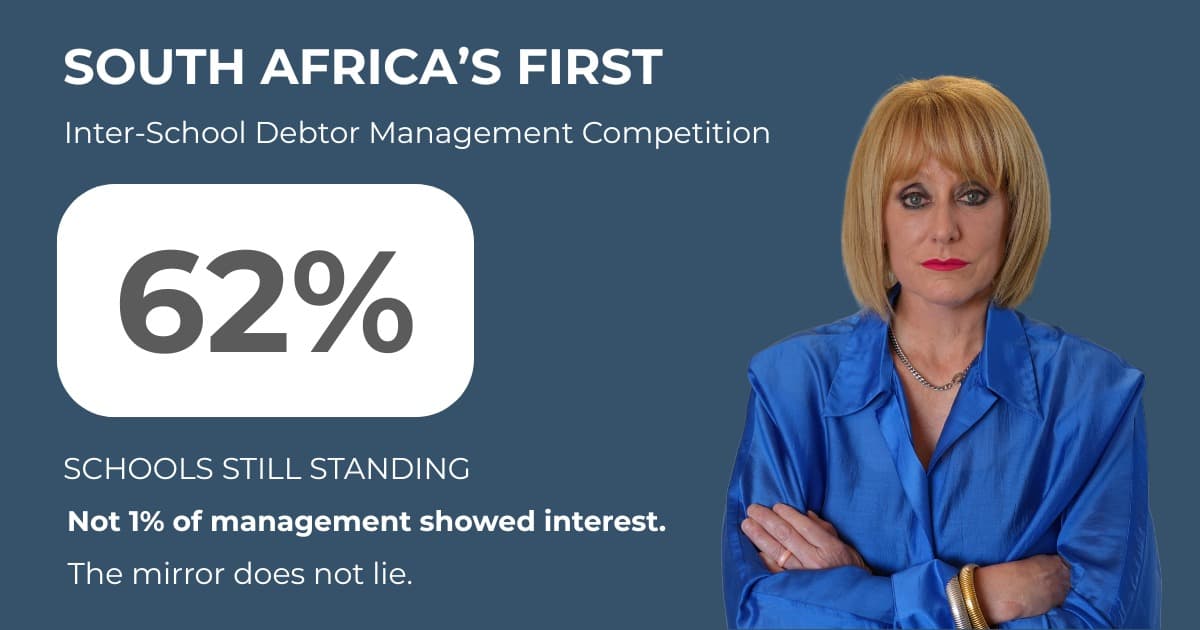
We are halfway through the year. 62% of our schools are still standing. That means 38% are not.
When you look at what separated the schools that stayed in from those that dropped out, and those that never really showed up at all, a clear pattern emerges. And that pattern has very little to do with the size of the school, the complexity of their debtor book, or the difficulty of the tasks.
It has everything to do with mindset, support, and the willingness to be held to a standard.
Some teams entered this competition knowing from day one they were going to be on that list in December. They were not all confident. Some were nervous about their system knowledge. Some knew the tasks would push them into uncomfortable territory. Picking up the phone, negotiating payment arrangements, and having difficult conversations with parents about overdue accounts. But they made a decision. They committed. And when challenges came up, because challenges always come up, they reached out, and together with the Jumping Fox Software team, they found a way through.
These are the teams still standing. They did not succeed because it was easy. They succeeded because they decided it was not optional. Some of them sat on a Friday afternoon, loading arrangements or making final calls before the month closed, because finishing was not something they were willing to negotiate on.
Other teams started with genuine intention but fell under the weight of everything else. Daily demands, meetings, reports, family and the relentless pressure of a full workload left no room for the focus the competition required. Some came in with less system knowledge than others and were already fighting harder just to keep up. Some were pushed out of their comfort zone by tasks that asked more of them than they had been asked to give before, and without the right support structure around them, that wall became too high to climb.
And some teams were simply never really in it. The competition landed as extra work on an already full plate. The connection between completing the tasks and actually improving their daily work, making their job easier, their results better, their professional standing stronger, never clicked. The willingness to try something new, to trust the process, to be led toward something better, was not there.
Three very different responses to the same opportunity. And the difference between them is not talent or capacity. It is the presence or absence of a standard.
Why is management not invested?
Here is the observation that sits at the heart of this blog.
Over the past six months, we have sent monthly emails to school management, updating them on the competition and telling them whether their team completed the month's tasks and is still in the race, or whether they are out. We post about the competition every month. We announce the schools that earn golden badges every month. We host monthly training sessions to help users get more comfortable with the system and with collection best practices.
In six months, across all those touchpoints, approximately 1% of schools out of the entire field have made any remarks at all. Nothing serious. No real questions. No curiosity about where their school stands relative to others. No question about what they could do to help their team succeed. No interest in understanding what a payment culture could mean for their school's financial health.
Read that again.
Your team may be sitting on a Friday afternoon making calls and loading arrangements to get the month's tasks done before the deadline. They may be learning new features, pushing through discomfort, navigating challenges, and doing all of it largely without your knowledge or support. They are self-motivated, self-driven, and self-investing. And the people responsible for the strategic direction of the school have no idea it is happening.
Why? Because there is no standard that requires them to know. No benchmark that makes management accountability and support in debtor management a non-negotiable part of running a school. Every school does what it thinks is good enough. Every management team supports to the level it thinks is acceptable. Every debtor management team goes as far as it thinks it needs to go.
And in the absence of a standard, the gap between what is possible and what is actually happening stays invisible. Until something like this competition holds up the mirror.
Playbook 1 is where every great payment culture begins. Free and practical.
What keeps these teams going
They can see where this road leads.
That is what separates them. Not skill. Not a lighter workload. Not a management team that makes everything easier. They have connected the dots between the work they do every month and the change that work will bring, for their school, for every learner that depends on it, for the debtor management role in this country, and for themselves.
That kind of clarity does not come from a competition. It comes from people who have decided to take their work seriously enough to see the bigger picture.
Recognition matters. Reward matters. Every one of these teams deserves both. But the absence of either did not stop a single one of them. They made a commitment to themselves, to their schools, and to a standard they refuse to walk away from.
They also chose to trust us. Not because we asked them to, but because more than two decades of working inside this space has earned it. We know what this role demands. We know what gets in the way. We know what management can do to change things, and what it takes to build a real payment culture at school level. That knowledge is what sits behind every task in this competition. And these teams know it.
To the schools that have fallen out, remember, your journey does not end here. The competition has rules, and the rules are the rules. But our community does not end when the competition does. The road to that same standard is still open.
We are still here.
What this means for the education sector
What this competition is revealing is not unique to the schools on our platform. It is a reflection of a systemic gap that exists across South African schools. A gap between the potential of the debtor management function and the reality of how it is resourced, supported, and led.
Debtor management does not fail because the people doing it are not good enough. It fails because no one has ever held it, or them, to a standard worth rising to.
The schools still standing in this competition have largely built that standard for themselves, with the Jumping Fox Software team walking every step of the journey with them. They did not wait for management to notice. They did not wait for permission or praise. They built something and they are still building it.
Imagine what becomes possible when management is in that conversation too.
The second half of this competition runs from July to December. Six more months. If you are a principal, a bursar, or a governing body member, now is the time to find out where your school stands. Ask your debtor management team what they have been working on. Find out whether your school is still in the race. And if they are, show up for them.
If you want to understand what building a payment culture looks like in practice, Playbook 1 is where every great payment culture begins. It is free and it is practical. Request your copy below.
Ready to start? Download Playbook 1, your free, practical guide to building a payment culture.
South Africa's first interschool debtor management competition. Halfway through. The bar is not coming down. 🦊
Daleen Vorster
Jumping Fox Software
jumpingfoxsoftware.com